
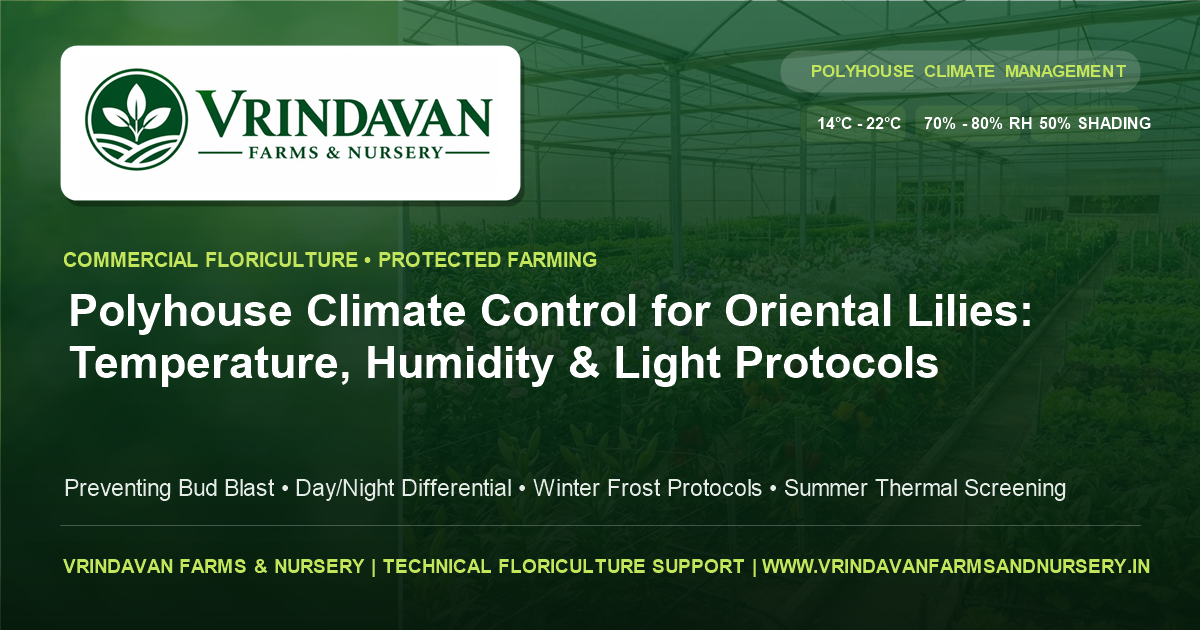
Agronomy Quick Reference: Oriental Lily Polyhouse Climate Targets
Oriental lilies (*Lilium orientalis*, such as Siberia, Sorbonne, and Marlon) are premium, cool-season cut flowers. Under Indian polyhouse conditions, strict microclimate control directly governs stem length, bud survival, and flower head size:
- Day Temperature: 20°C – 24°C (maximum tolerance 27°C with shading and misting).
- Night Temperature: 13°C – 15°C (cooling night differential ensures strong, thick stems).
- Root Zone Temperature: 12°C – 15°C during the first 3–4 weeks for stem-root establishment.
- Relative Humidity (RH): 70% – 80% during daylight; prevent condensation drops on leaves at dawn.
- Shading Strategy: 50% thermal/shade screen during bright winter days; 70% aluminet screen during early autumn and late spring transitions.
Among commercial floriculture crops grown under protected cultivation in India, cut Oriental lilies command the highest per-stem realization at mandis like Delhi (Ghazipur), Bengaluru, Pune, and Kolkata. However, unlike hardy field crops, lilies possess a delicate physiological threshold where minor microclimatic spikes can trigger irreversible crop damage—most notably bud abortion (bud blast), physiological leaf scorch, and stunted stems.
At Vrindavan Farms & Nursery, we supply certified Dutch flower bulbs alongside full agronomic technical support to polyhouse growers across Haryana, Punjab, Rajasthan, and Himachal Pradesh. Below is the field-tested climate control protocol tailored specifically to the North Indian plains and sub-Himalayan valleys.
1. Temperature Regulation & The “DIF” Concept
Temperature dictates both the rate of plant development and stem rigidity. In commercial greenhouse management, growers use DIF (the difference between day temperature and night temperature):
- Positive DIF (+5°C to +8°C): Having day temperatures around 20°C–22°C and night temperatures at 14°C–15°C promotes steady internode elongation, resulting in the desired 90–110 cm export-grade stems.
- Extreme Positive DIF (>15°C): Common in North Indian winters where sunny days reach 25°C while unheated nights drop to 4°C–6°C. Excessive night chill slows nutrient uptake, causing thick, short stems (“cabbage heads”) and delayed flowering.
- High Night Heat (>20°C): Accelerates respiration, burning stored carbohydrates and causing thin, weak stems with pale foliage and fewer open buds.
Root Zone Temperature: The Most Overlooked Factor
During the critical first 21 to 28 days following planting, the bulb must establish adventitious stem roots emerging from the subterranean stem above the bulb. Stem roots require cool soil temperatures between 12°C and 15°C. If polyhouse soil exceeds 18°C during early rooting, the sprout stretches prematurely before the root system can sustain transpiration, leading to catastrophic bud abortion later in the cycle.
To keep beds cool, apply a 2-inch layer of clean paddy straw or cocopeat mulch immediately after planting pre-cooled bulbs from our Imported Lily Bulbs Supplier catalog.
2. Relative Humidity (RH) & Vapor Pressure Deficit (VPD)
Maintaining the delicate equilibrium between air moisture and transpiration is essential for preventing both leaf tip scorch and fungal outbreaks:
The 70% – 80% RH Golden Window
Lilies transpire copiously. If relative humidity drops below 55% during warm dry afternoons, the stomata close rapidly, halting calcium delivery to expanding bud tips. This calcium deficiency manifests as leaf scorch (chlorotic curling of upper bracts).
Conversely, if humidity remains at 95%–100% overnight with no air movement, water droplets condense on petal tissue at dawn, creating the perfect incubation ground for Botrytis cinerea (gray mold).
Ventilation Strategy: In naturally ventilated polyhouses (NVPH), open top ridge vents and side curtains early in the morning for 20–30 minutes to exhaust humid, stagnant night air before temperatures rise. Discover complete greenhouse designs in our Polyhouse Farming Solutions portfolio.
3. Light Intensity, Shading & Photoperiod
Oriental lilies require diffuse, high-quality light for photosynthesis, but direct solar radiation in sunny regions can scorch tender foliage:
- Optimal Light Level: 25,000 to 35,000 Lux (approximately 400–600 µmol/m²/s PAR).
- Shade Net Timing: Deploy a retractable 50% aluminet thermal screen from 11:00 AM to 3:30 PM during sunny spells. Retract the screen in the early morning and late afternoon to allow maximum light penetration.
- Light Deficiency Risk: During prolonged foggy or overcast conditions in December/January across Haryana, Punjab, and Uttar Pradesh, low ambient light combined with crowded planting density (over 38 bulbs/m²) leads to bud yellowing and abortion. Always adjust spacing according to your caliber, as detailed in our Lily Bulb Sizes Commercial Guide.
Growth Stage Climate Parameter Summary
The table below summarizes ideal environmental targets throughout the 90-day cultivation cycle of Oriental lilies:
| Growth Stage | Day Temp (°C) | Night Temp (°C) | Relative Humidity | Shading & Airflow Action |
|---|---|---|---|---|
| Rooting (Days 1–21) | 16°C – 18°C | 12°C – 14°C | 75% – 85% | Heavy shading (60–70%), cool soil with mulch |
| Vegetative & Elongation (Days 22–50) | 20°C – 22°C | 14°C – 15°C | 70% – 75% | 50% diffuse light; maintain active air exchange |
| Bud Initiation (Days 51–75) | 21°C – 23°C | 14°C – 16°C | 70% – 80% | Prevent midday heat >26°C; ensure adequate calcium uptake |
| Color Showing & Harvest (Days 76–90) | 18°C – 20°C | 12°C – 14°C | 65% – 70% | Slightly cooler regime intensifies petal coloration and vase life |
4. Seasonal Climate Protocols for North Indian Growers
Winter Season (November to February)
Winter provides the best natural temperature range across Haryana, Western UP, and Punjab, but frost and dense fog create unique hurdles:
- Frost Protection: Close side curtains before sunset (around 5:00 PM) to retain stored radiant soil warmth. In extreme sub-zero dips, run overhead misting lines for 5 minutes during pre-dawn hours or utilize thermal screen closures.
- Fertigation Integration: Cold soil reduces nitrogen and phosphorus absorption. Maintain balanced fertigation regimes with water-soluble fertilizers as outlined in our Fertigation & Nutrient Management agronomy guide.
Spring Transition (March to April)
As daytime temperatures begin climbing past 28°C in March, growers must deploy evaporative cooling (cooling pad & fan systems or high-pressure fogging systems) to prevent rapid forced blooming with short stem lengths.
Need Expert Polyhouse Climate & Bulb Consultation?
From naturally ventilated polyhouse design and climate sensors to cold-chain bulb sourcing, Vrindavan Farms & Nursery supports floriculture entrepreneurs from bed preparation to flower harvest.
Frequently Asked Questions (FAQ)
Q1: What is the primary cause of bud abortion (bud blast) in Oriental lilies?
Bud abortion is triggered when greenhouse temperatures exceed 27°C during the bud initiation stage (Day 45–60), especially when combined with low light levels or high root-zone temperatures that restrict calcium uptake to growing flower buds.
Q2: Can I grow Oriental lilies in a naturally ventilated polyhouse (NVPH) without cooling pads?
Yes, during the North Indian winter season (planting from October to December for January to March harvests), naturally ventilated polyhouses with 50% top shading and operable side curtains perform exceptionally well. For summer cycles (April–June), forced cooling pads and exhaust fans become essential.
Q3: How do I prevent Botrytis fungal spots on lily petals before harvest?
Maintain nighttime humidity below 85% by opening top ridge vents at dawn to clear condensation. Never irrigate plants overhead after the flower buds have opened, and ensure gentle air movement with horizontal circulation fans.
Q4: What shade net percentage is best for cut lilies in North India?
A 50% green or white aluminet thermal shade screen is recommended. In peak sunny afternoons (March/April), a 70% screen may be utilized temporarily during midday hours to prevent leaf scorching.
For complete farming solutions, visit our dedicated sections on Polyhouse Farming Solutions and Commercial Floriculture.